


Start choosing lights with your ceiling and the room’s needs. One fitting sits on a finished surface, another needs space inside the construction, and a third needs clearance for a suspension. A good-looking idea must also be practical to install.
Compare surface-mounted, recessed and pendant lights in the Luminance catalogue. The steps below will help narrow the selection to suitable options.
1. Check the starting conditions
Room height is only part of the picture: ceiling construction matters too. Concrete, plasterboard and stretch ceilings require different arrangements for fixing and placing equipment.
Note whether the ceiling is finished or still being planned, where the cables run, whether there is space for the body and driver, and where the table, sofa and walkways will be. These answers are more useful than choosing from a photograph alone.
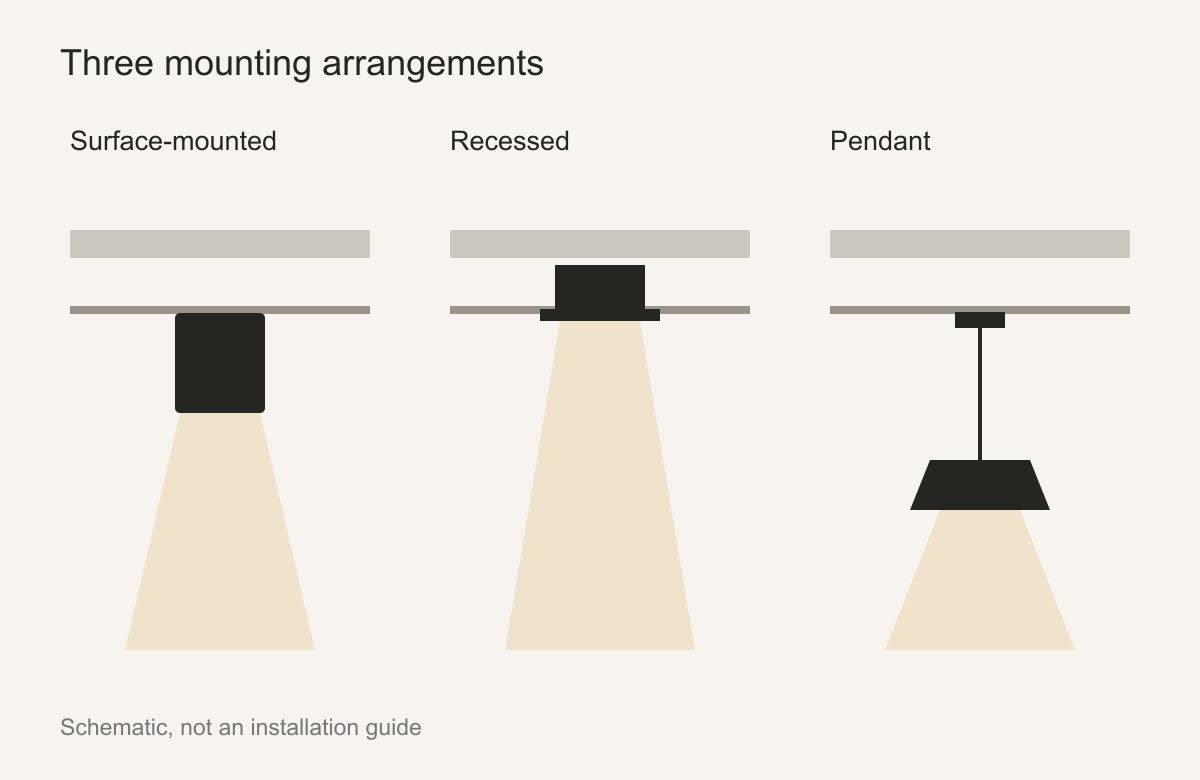
2. Surface-mounted: a visible fitting
A surface-mounted fitting sits below the ceiling plane. Consider it when you do not want to lower a ceiling to accommodate recessed models. Fixings, the cable outlet and electrical connection still need planning.
The body becomes part of the interior: compare its height, diameter and side profile. Compact options deserve particular attention in a low room. Surface mounting does not itself determine whether light is broad or focused — that depends on the optics.
Explore surface-mounted lights and relate the body dimensions to your room.
3. Recessed: plan before finishing
Most of a recessed fitting’s body sits behind the ceiling plane. Before buying, check installation depth, cut-out size, required clearances and access for maintenance. Matching the outside diameter alone is not enough.
For a stretch ceiling, agree on the appropriate support and mounting components with the installer. For plasterboard, account for the construction thickness and framing positions. There is no universal recess depth for every fitting: use the selected product’s documentation.
In the recessed lighting range, check installation suitability first, then compare light performance and appearance.
4. Pendant: relate it to furniture and movement
A pendant can define a table, island or other composition. Position it in relation to the furniture rather than automatically in the centre of the room. If the table is not selected yet, establish its likely size and location.
Check suspension length and adjustability, fitting weight and fixing requirements. Above a table, consider seated sightlines; in a walkway, consider clear movement. Do not apply one hanging height to every room.
Compare the scale of pendants and chandeliers: a small shade and a long linear fitting shape a space differently.
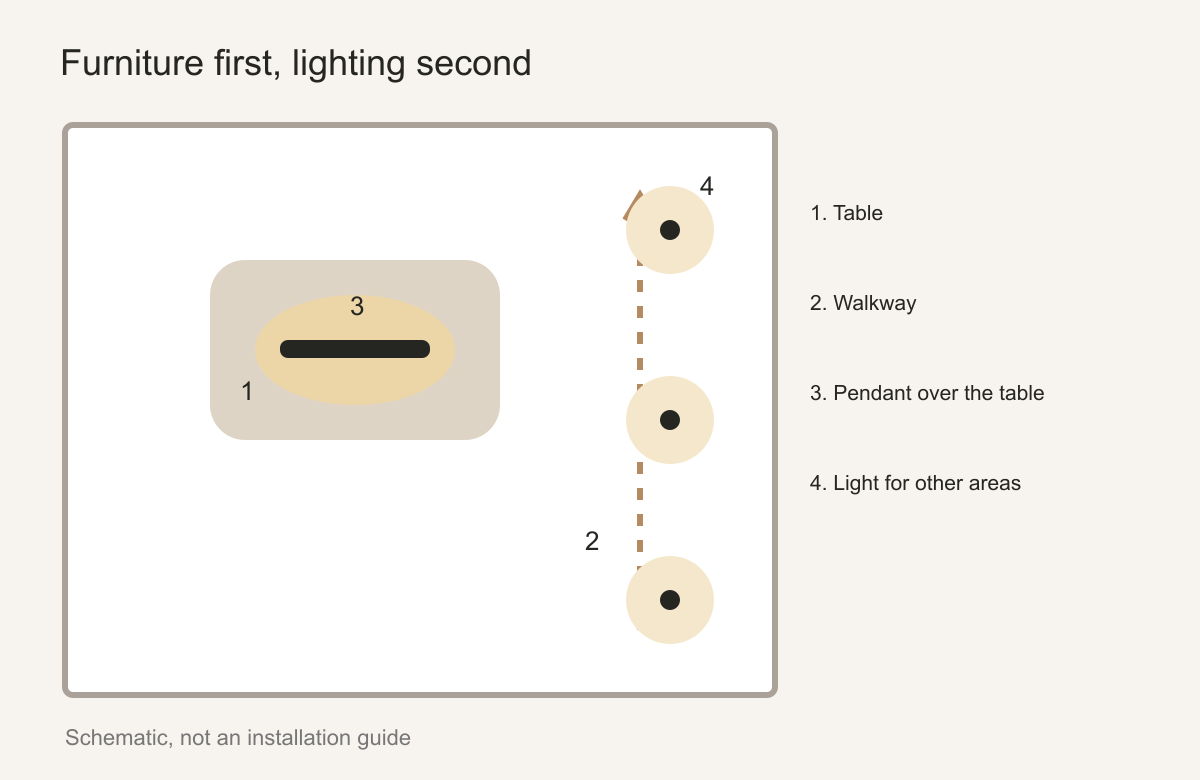
5. Combine types within one room
For example, a pendant above the table can work alongside surface-mounted or recessed lighting elsewhere. This is a planning suggestion, not a mandatory package. What matters is a clear job for each source.
Decide early which groups should switch separately and whether dimming is needed. A mounting type does not guarantee dimmer compatibility. Also compare light output, beam angle, colour temperature and visual comfort.
6. A checklist before ordering
Check the selected models against the plan and their installation requirements. Involve a qualified professional for electrical connection and assessment of the fixing surface.
- Ceiling type, fixing location and maintenance access.
- Body dimensions, cut-out or suspension length.
- Furniture positions and clear walking routes.
- Control compatibility and required accessories.
- Quantities, finishes and agreed delivery timing.
Choose lighting around your ceiling
Send a room plan or photograph, ceiling height and ceiling type. Luminance helps select and supply lighting for homes and projects.
Explore lighting