




Autumn and winter in Estonia bring long, dark evenings. During this period, home lighting affects more than visibility: it influences the atmosphere of a room, concentration and the ability to relax at the end of the day. A good lighting plan does not mean making the entire home as bright as possible. It means putting the right light in the right place.
1. Do not rely on one ceiling light
One powerful fixture in the centre of the ceiling may brighten a room, but it can also create harsh shadows and tiring contrast. A comfortable interior combines three layers:
- Ambient light provides even background illumination and helps people move safely through the room.
- Task light illuminates kitchen worktops, desks, dining tables and reading areas.
- Accent light highlights a wall, artwork, shelf or architectural feature.
Layering makes the room flexible. Bright ambient light can be used for cleaning, while a calm evening setting may use only wall lights, a floor lamp or a few directed track lights.
2. Match the colour temperature to the activity
Colour temperature is measured in kelvins. During the dark season, it helps to separate different situations:
- 2700–3000 K creates a warm, relaxed atmosphere in living rooms and bedrooms.
- 3000–4000 K works well in kitchens, work areas and home offices where clearer visibility is useful.
- Tunable white lighting is practical in a room used for work during the day and relaxation in the evening.
Not every lamp in the home must have exactly the same colour temperature. However, within one field of view, avoid an accidental mixture of very yellow light and cold blue-white light.
3. Check lumens, not only watts
Watts mainly describe electricity consumption, while lumens describe the amount of light. A modern LED luminaire can produce plenty of light with relatively little power. Beam angle and the size of the illuminated surface are also important.
Several moderate light sources are often more comfortable than one extremely bright fixture. They can be divided into zones and switched on only where light is actually needed.
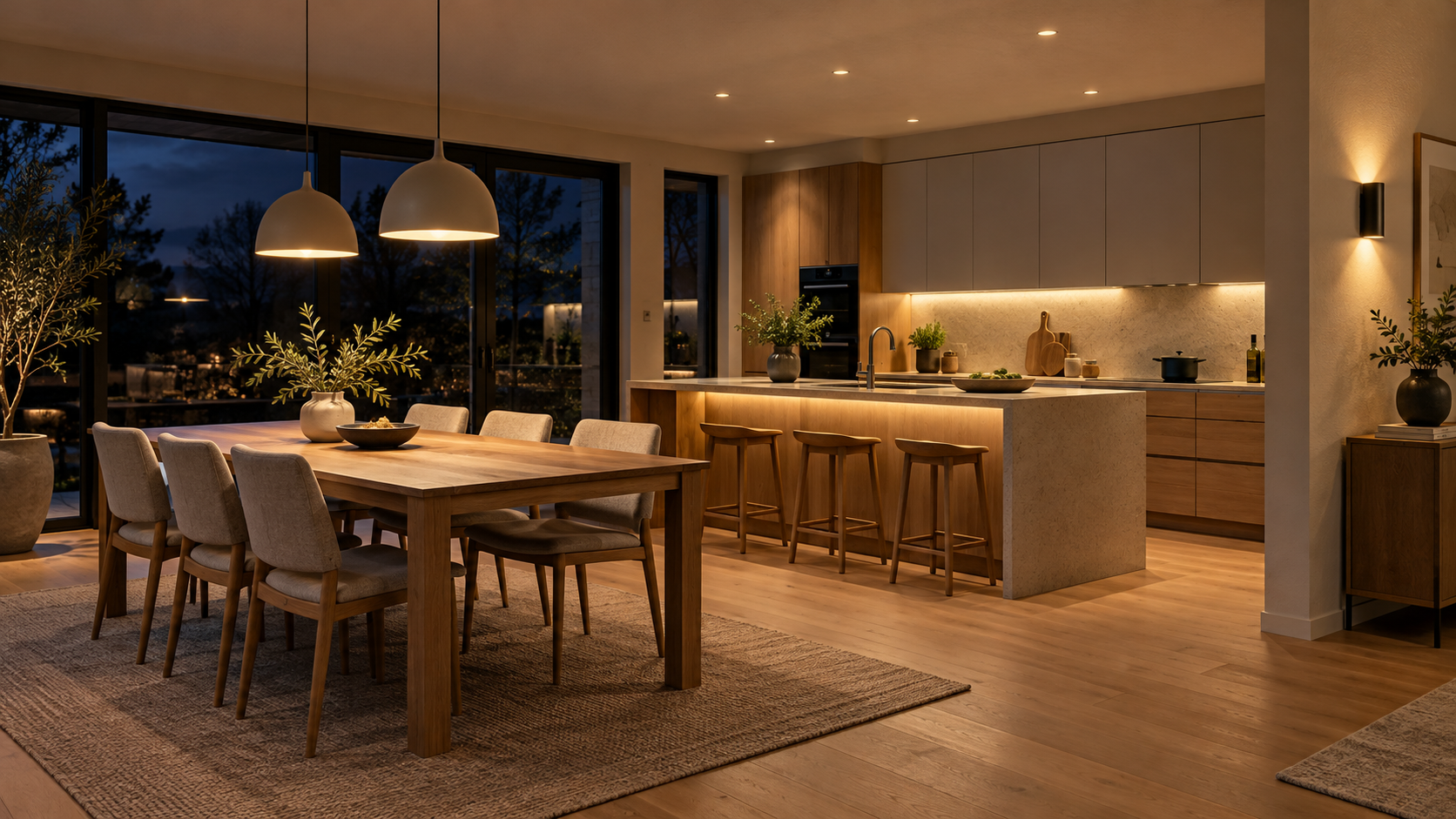
4. Illuminate the activity, not an empty floor
In a kitchen, light should reach the worktop rather than remain behind the person preparing food. A reading light should come from the side or slightly behind the shoulder. A lower pendant above the dining table creates a defined and welcoming pool of light.
In a living room, a track lighting system can provide both ambient and accent lighting: some luminaires illuminate the room, while others are aimed at walls or interior details. The catalogue also includes recessed, surface-mounted and pendant luminaires for different ceiling types.
5. Reduce glare and reflections
Even a powerful, high-quality luminaire can be uncomfortable when its light source is directly visible from a seated position. This is particularly important around sofas, televisions, dining tables and home workstations.
Before installation, check:
- whether the light source is directly visible from a chair or sofa;
- whether it is reflected in a television or computer monitor;
- whether an adjustable spotlight illuminates the intended object rather than a person's face;
- whether the shade or diffuser softens the light sufficiently.
6. Use dimming and lighting scenes
During the dark season, lighting operates for many hours every day. Dimming makes it possible to reduce brightness in the evening without leaving the room dark. Smart control can store separate settings for working, entertaining guests, watching a film and relaxing.
Motion sensors can prevent lights from remaining on for hours in corridors, wardrobes and utility rooms. In the European Union, light sources use the rescaled A–G energy label, which also states electricity consumption per 1,000 operating hours.
7. Make evening light calmer
At the end of the day, the same brightness used for working or cleaning is rarely necessary. Turn off strong ambient light, lower the brightness and use warm wall, table or floor lamps. Visibility remains comfortable while the room becomes more suitable for rest.
Quick checklist
- Does each room have task or accent lighting in addition to ambient light?
- Are the kitchen worktop and desk illuminated separately?
- Are seated people protected from direct glare?
- Can the light be dimmed or switched by zones in the evening?
- Do the most frequently used luminaires use energy-efficient LED light sources?
Well-planned lighting makes the dark season significantly more comfortable. Explore the Luminance catalogue or contact our team for help combining ambient, task and accent lighting into one practical solution.
Source: European Commission — Light sources.