


In the morning, a bathroom needs useful light at the mirror; in the evening, a calmer atmosphere. But an attractive fitting and a pleasant light colour are not enough: the luminaire must suit the conditions at its actual installation position. Here is what IP44 and IP65 mean, and how to combine comfort with a considered choice.
Start with the Luminance lighting catalogue and compare intended use as well as specifications. Not every wall or ceiling light is suitable for a bathroom: check the IP rating and instructions for the exact product code.
1. What do the IP numbers mean?
An IP code describes the enclosure’s protection against the ingress of solids and water. The first digit concerns solids; the second concerns water. Read them separately: IP65 is not simply “21 points better” than IP44.
With IP44, the first digit indicates protection against solid objects larger than 1 mm; the second indicates protection against splashing water from different directions. IP65 means a dust-tight enclosure with protection against water jets under standard test conditions. Neither marking alone establishes suitability for immersion.
IP44 — Splash protection
A candidate for suitable positions without water jets, subject to zone requirements and the manufacturer’s instructions.
IP65 — Water-jet protection
Consider for the relevant water exposure; not approval for immersion or every position in a shower.
2. IP44 or IP65: start with the installation position
Consider IP44 for suitable positions exposed to splashes rather than water jets, provided the manufacturer permits that use and the requirements for the particular zone are met. It may suit some mirror-lighting positions, but an IP44 label is not permission to install a fitting anywhere in a bathroom.
Where a shower spray or cleaning water jet could reach the luminaire, splash protection does not address that exposure. A jet-protected design, such as IP65, should then be considered, with the manufacturer’s permitted installation positions checked separately. Even IP65 is not blanket approval for any position inside a shower.
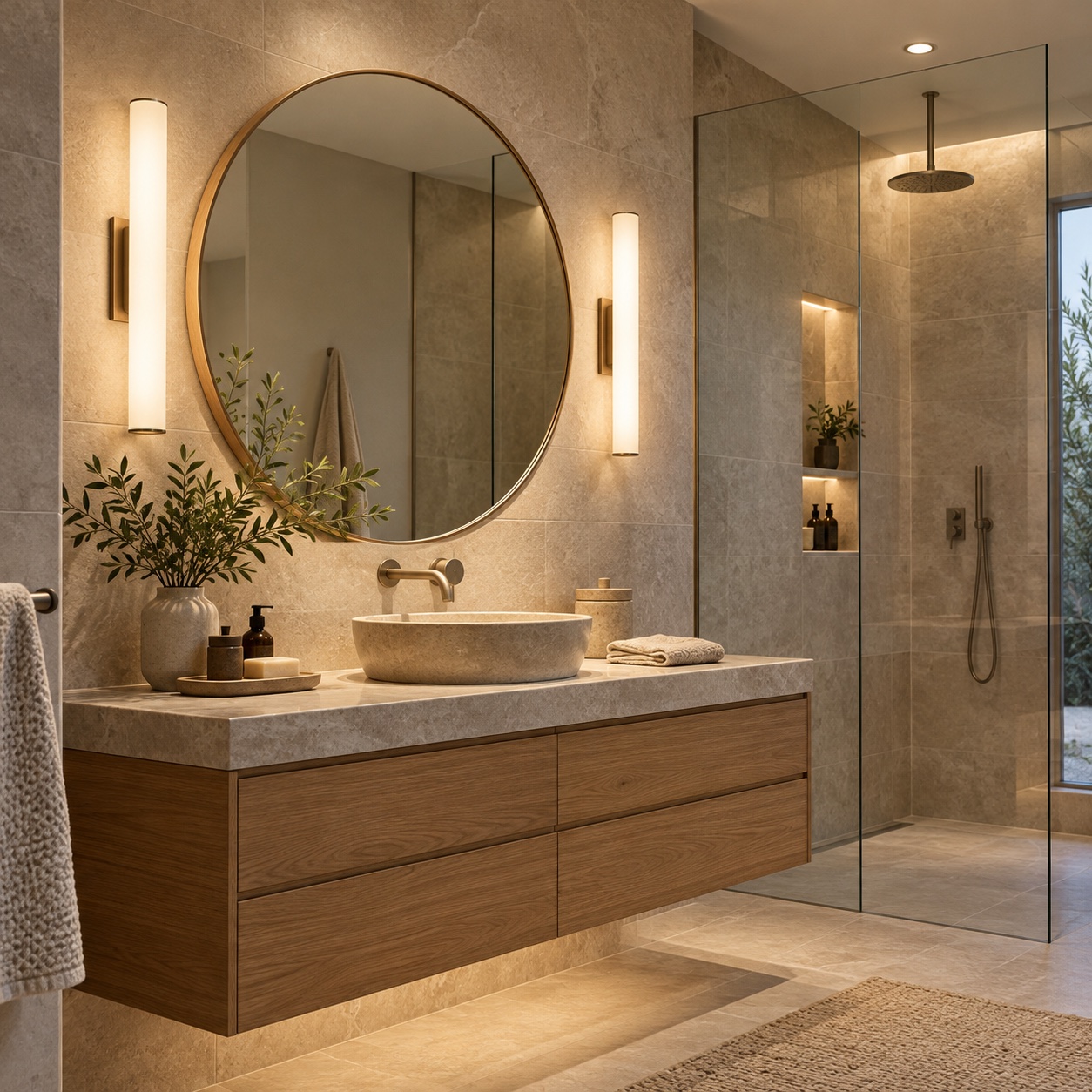
3. Why judging distances by eye is not enough
A bath, shower tray, open shower, partitions and water-outlet position all affect the assessment. A mirror does not automatically create an “IP44 zone” around itself, and a high ceiling does not by itself remove restrictions.
In Estonia, locations containing a bath or shower are covered by EVS-HD 60364-7-701:2024+A11:2024. A qualified electrician should verify zone boundaries, permitted equipment and protective measures against the applicable requirements. This article helps with choosing luminaires; it is not an electrical design or an installation guide.
4. Mirror lighting: fewer shadows, more comfort
A single ceiling light above your head can cast shadows beneath the eyes and chin. For daily routines, adding diffuse light closer to the face can help: for example, two coordinated lights beside the mirror. A broad light above it is another option; the result depends on optics and positioning.
Compare wall lights, then check which versions are approved for humid conditions and the chosen position. Comfortable brightness, glare control and good colour rendering matter for facial care. CRI 90 or above is a useful selection target, rather than a guarantee of a perfect result.
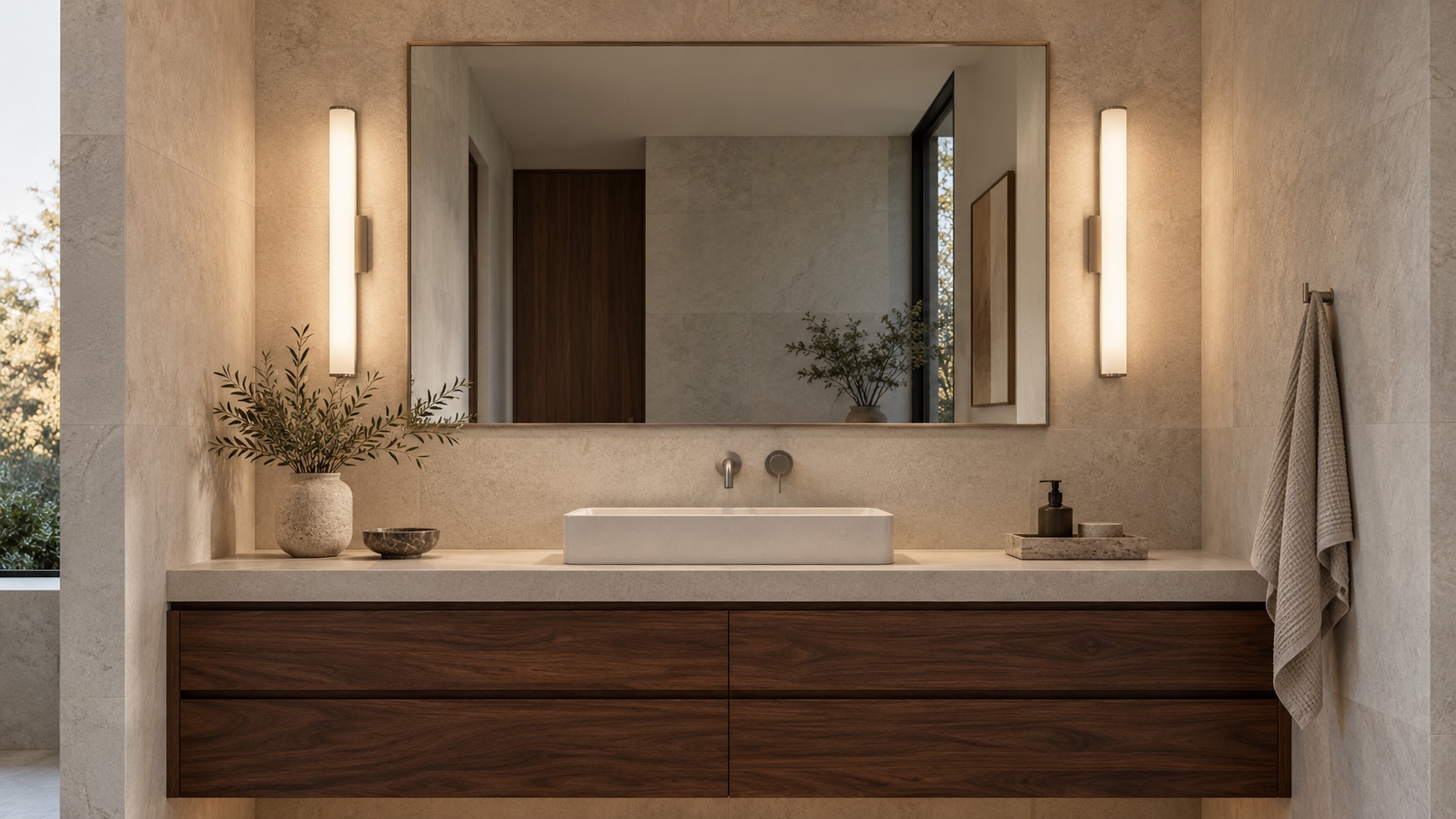
5. General, task and evening lighting have different jobs
General lighting helps with moving around and cleaning; task lighting serves the mirror; evening lighting avoids illuminating the entire room at full brightness. Even a compact bathroom can separate these jobs, with one scene for morning routines and another for a relaxed evening.
Explore ceiling lights and select a suitable version from its instructions, not its appearance alone. For a cosy atmosphere, begin by comparing 3000K; for a more neutral impression, try 4000K. This is a preference, not a water-protection requirement. Dimming needs compatible luminaires, drivers and controls.
6. Five mistakes that are easy to avoid
Do not treat IP65 as protection against every condition. IP does not describe every risk: condensation, permitted temperature and intended use still matter. A steam room or sauna needs a separate assessment; a high IP number does not turn an ordinary bathroom fitting into a sauna light.
For a recessed light, do not look only at the face. The documentation may state different protection on the room side and rear; drivers and connections also need suitable positioning. A conventional LED bulb in an open holder does not make the assembly moisture-resistant simply because of a marking on the light-source packaging.
- Do not apply one version’s rating to an entire range.
- Do not confuse enclosure protection with the safety of the complete installation.
- Do not choose an installation position from an interior photograph.
- Do not overlook drivers and connections.
- Do not use an IP code as a replacement for the manufacturer’s instructions.
7. What should you check before ordering?
Define the positions and lighting scenes first, then choose the luminaires. A well-designed bathroom does not need the highest IP number everywhere; it needs equipment correctly selected for the actual conditions.
If you are unsure, prepare a room plan showing the bath, shower and mirror. It will help you discuss lighting options with Luminance and agree permitted installation positions with an electrician before buying, rather than after the finishes are complete.
- Exact product code, IP rating and manufacturer-approved use.
- Installation position and electrical zone checked by an electrician.
- Protection of the enclosure, driver and connections in the specified assembly.
- Light output, colour rendering and comfortable colour temperature.
- Dimming compatibility if an evening scene is required.
Start with the task, then find the right light
Compare luminaires in the Luminance catalogue. For a bathroom, check the exact product’s IP rating, intended use and instructions, and agree its installation position with an electrician.
Explore the catalogue